
Medically reviewed by Amit Kimothi, BCMAS, Pharmacist | Last updated: March 2026 |
IBD and IBS — the names look almost identical, and both conditions affect the digestive system. But they are fundamentally different diseases with different causes, different levels of seriousness, and very different treatment approaches. Confusing the two can lead to delayed diagnosis and the wrong treatment plan.
This guide explains everything you need to know about IBD vs IBS — in plain language, backed by current medical evidence.
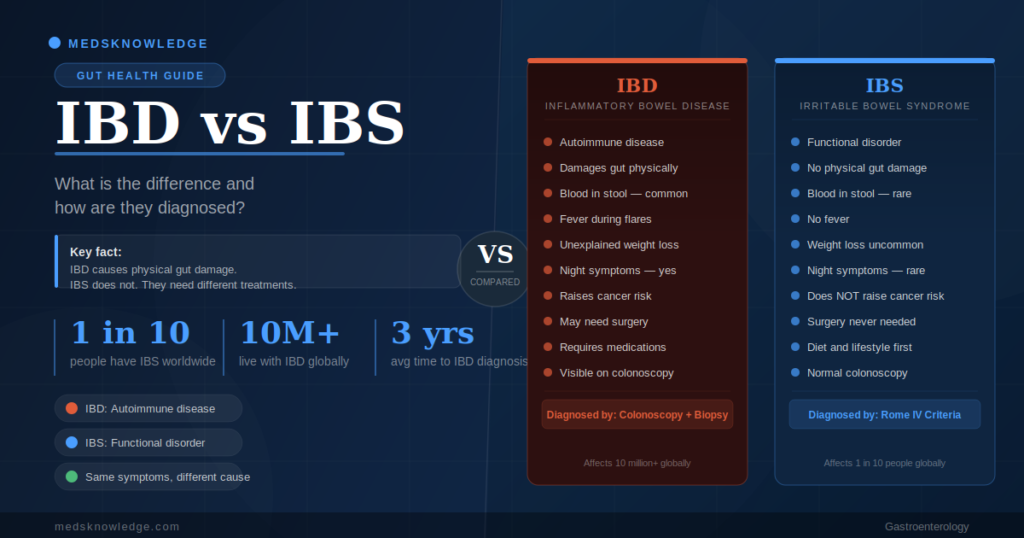
Key takeaway: IBD is a serious autoimmune disease that causes physical damage to the gut. IBS is a functional disorder — the gut looks normal but does not work properly. Both are real, both need treatment, but they are not the same thing.
What Is IBD?
IBD stands for Inflammatory Bowel Disease. It is a chronic autoimmune condition in which the immune system mistakenly attacks the lining of the digestive tract, causing inflammation, ulcers, and lasting physical damage.
There are two main types of IBD:
- Crohn’s disease — can affect any part of the digestive tract from the mouth to the anus. Inflammation occurs in patches and can penetrate deep into bowel tissue.
- Ulcerative colitis (UC) — affects only the colon (large intestine) and rectum. Causes continuous inflammation and ulcers along the inner lining of the colon.
IBD is a lifelong condition. Without proper treatment, it can lead to serious complications including bowel obstruction, fistulas, malnutrition, and an increased risk of colorectal cancer.
What Is IBS?
IBS stands for Irritable Bowel Syndrome. It is a functional gastrointestinal disorder — meaning the digestive system looks completely normal on scans and biopsies, but it does not function properly.
IBS is characterised by a group of symptoms — particularly abdominal pain and changes in bowel habits — that occur together without any identifiable structural cause. There are three main subtypes:
- IBS-C — IBS with predominant constipation
- IBS-D — IBS with predominant diarrhoea
- IBS-M — IBS with mixed bowel habits (alternating between constipation and diarrhoea)
IBS does not cause physical damage to the intestines and does not increase the risk of colorectal cancer. However, it significantly impacts quality of life and is one of the most common reasons people visit a gastroenterologist.
Important distinction: IBS is diagnosed based on symptoms alone using the Rome IV criteria. IBD requires physical evidence of inflammation through blood tests, colonoscopy, or biopsy.
IBD vs IBS — Side-by-Side Comparison
| Feature | IBD | IBS |
|---|---|---|
| Type of condition | Autoimmune disease | Functional disorder |
| Gut damage | Yes — causes physical damage | No — gut looks completely normal |
| Visible on colonoscopy | Yes — ulcers and inflammation visible | No — colonoscopy appears normal |
| Blood in stool | Common — major red flag | Rare — not a typical symptom |
| Fever | Yes, during flares | No |
| Unexplained weight loss | Common | Uncommon |
| Night-time symptoms | Yes — can wake patients from sleep | Rarely |
| Raises cancer risk | Yes — especially in ulcerative colitis | No |
| Requires surgery | Sometimes — up to 70% of Crohn’s cases | Never |
| How common | 10 million+ people globally | 1 in 10 people worldwide |
| Diagnosed by | Colonoscopy and biopsy | Symptoms using Rome IV criteria |
Symptoms: How IBD and IBS Differ
While both conditions share some overlapping symptoms — particularly abdominal pain and diarrhoea — there are key warning signs that help distinguish them:
| Symptom | IBD | IBS |
|---|---|---|
| Abdominal pain and cramping | Common | Common — key symptom |
| Diarrhoea | Common, may be bloody | Common — no blood |
| Constipation | Occasionally | Common in IBS-C subtype |
| Blood in stool | Common — red flag symptom | Rare — not typical |
| Mucus in stool | Yes | Yes |
| Fever | Yes — during flares | No |
| Unexplained weight loss | Yes — common | No |
| Fatigue | Significant and persistent | Mild to moderate |
| Night-time symptoms | Yes — wakes patients from sleep | Rarely occurs at night |
| Joint pain or skin issues | Yes — extraintestinal symptoms | No |
| Bloating | Sometimes | Very common |
| Relief after bowel movement | Sometimes | Often yes |
See a doctor immediately if you have: Blood in your stool, unexplained weight loss, fever alongside bowel symptoms, or symptoms that wake you from sleep. These are red flags for IBD — not IBS.
Causes: Why IBD and IBS Happen
What Causes IBD?
IBD is caused by an abnormal immune response. For reasons not yet fully understood, the immune system attacks the healthy cells of the digestive tract as if they were foreign invaders. Contributing factors include:
- Genetics — having a first-degree relative with IBD significantly increases your risk
- Immune system dysfunction — a malfunctioning immune response triggers chronic gut inflammation
- Gut microbiome imbalance — disrupted gut bacteria appear to play a triggering role
- Environmental triggers — smoking, certain medications such as NSAIDs, and a Western diet are all linked to higher risk
What Causes IBS?
The exact cause of IBS is not fully understood, but it is believed to involve a combination of the following factors:
- Gut-brain axis dysfunction — abnormal communication between the brain and the digestive system
- Visceral hypersensitivity — the gut is overly sensitive to normal digestive sensations and pressure
- Post-infectious IBS — up to 30% of cases develop after a gut infection such as gastroenteritis
- Food sensitivities — particularly to high-FODMAP foods which are fermentable carbohydrates
- Stress and anxiety — the gut has its own nervous system and responds strongly to emotional stress
- Hormonal factors — symptoms are often worse around menstruation, which explains why IBS affects more women than men
How Each Condition Is Diagnosed
Diagnosing IBD
IBD requires objective evidence of inflammation. Diagnosis typically involves a combination of the following tests:
- Blood tests — elevated CRP and ESR as inflammation markers, low haemoglobin indicating anaemia, elevated white blood cell count
- Stool tests — faecal calprotectin is a highly specific marker of gut inflammation; a positive result strongly suggests IBD rather than IBS
- Colonoscopy with biopsy — the gold standard test; shows ulcers and inflammation and allows tissue sampling for laboratory analysis
- MRI or CT scan — assesses the extent of disease, particularly useful in Crohn’s disease affecting the small intestine
- Capsule endoscopy — a swallowable camera pill used to visualise the small intestine in detail
Diagnosing IBS
IBS is a diagnosis of exclusion — meaning IBD and other structural causes must first be ruled out. Doctors use the Rome IV criteria to diagnose IBS:
Rome IV criteria for IBS: Recurrent abdominal pain on average at least 1 day per week in the last 3 months, associated with 2 or more of the following: (1) related to defecation, (2) associated with a change in stool frequency, (3) associated with a change in stool form or appearance.
If blood tests and faecal calprotectin results are normal and symptoms fit the Rome IV criteria, IBS is the likely diagnosis. A colonoscopy is usually not necessary for straightforward IBS in younger patients without alarm symptoms.
Treatment Differences
| Treatment Approach | IBD | IBS |
|---|---|---|
| Diet changes | Anti-inflammatory diet; avoid personal trigger foods | Low-FODMAP diet — highly effective for most patients |
| Medications | Aminosalicylates, corticosteroids, biologics such as infliximab | Antispasmodics, laxatives, antidiarrhoeals as needed |
| Immunosuppressants | Yes — azathioprine, methotrexate commonly used | No — not required |
| Biologic therapy | Yes — for moderate to severe IBD cases | No |
| Surgery | Required in approximately 25% of UC and 70% of Crohn’s cases | Never required for IBS |
| Probiotics | Limited and inconsistent evidence | Some benefit shown in clinical studies |
| Psychological therapy | Supportive role in managing chronic illness | CBT is highly effective — considered a core treatment |
| Stress management | Helps manage flare frequency | Central and essential part of treatment |
Can You Have Both IBD and IBS at the Same Time?
Yes — and this is more common than many people realise. Studies show that up to 33% of IBD patients in remission continue to experience IBS-like symptoms even when their IBD is under full medical control. This is known as IBS overlap or functional symptoms in IBD.
This matters significantly because treating only the IBD will not resolve the functional IBS symptoms. Patients in this situation often benefit from a combined approach — IBD medication for inflammation management combined with a low-FODMAP diet and gut-brain therapies for the functional symptoms.
When to See a Doctor
See your doctor promptly if you experience any of the following symptoms:
- Blood in your stool — whether bright red or dark and tarry
- Unexplained weight loss of more than 5% of your body weight over a few months
- Fever alongside any digestive symptoms
- Symptoms that wake you up from sleep at night
- Persistent diarrhoea lasting more than 4 weeks
- A family history of IBD or colorectal cancer
- New bowel symptoms appearing for the first time after the age of 50
Do not self-diagnose: Both IBD and IBS require proper medical evaluation. Early diagnosis of IBD in particular can prevent serious complications including permanent bowel damage and significantly increased cancer risk.
Frequently Asked Questions
Is IBD more serious than IBS?
Yes. IBD is a chronic autoimmune disease that causes physical damage to the gut and can lead to serious complications including bowel obstruction, surgery, and increased colorectal cancer risk. IBS is a functional disorder — it is uncomfortable and significantly affects quality of life, but it does not cause physical damage or increase cancer risk.
Can a blood test tell the difference between IBD and IBS?
Partially. Blood tests showing elevated CRP, elevated ESR, or anaemia suggest IBD. A faecal calprotectin stool test is particularly useful — a high result strongly suggests IBD while a normal result makes IBD unlikely. However, a colonoscopy with biopsy is usually needed for a definitive IBD diagnosis.
What does IBD pain feel like compared to IBS pain?
IBD pain tends to be more severe, persistent, and located in a specific area — often the lower right abdomen in Crohn’s disease or the lower left abdomen in ulcerative colitis. IBS pain is typically crampy, comes and goes, is often relieved after a bowel movement, and is associated with bloating and changes in stool consistency.
Which is more common — IBD or IBS?
IBS is significantly more common, affecting around 10 to 15% of the global population. IBD affects approximately 0.3% of people in Western countries, though rates are rising globally. Both conditions are diagnosed more frequently in younger adults between the ages of 20 and 40.
Can stress cause IBD?
Stress does not cause IBD, but it can trigger flares in people who already have the condition. Stress is much more directly linked to IBS — it can both trigger and significantly worsen IBS symptoms, as the gut and brain communicate constantly through what is known as the gut-brain axis.
Does the low-FODMAP diet work for IBD?
The low-FODMAP diet was developed primarily for IBS and is highly effective for managing IBS symptoms. In IBD patients who also have IBS overlap, it may help reduce functional symptoms. However, IBD treatment itself requires medical therapy — diet alone cannot control IBD inflammation.
Is IBS a lifelong condition?
For many people IBS is a long-term condition, but symptoms can improve significantly with dietary changes, stress management, and appropriate treatment. Some people find their IBS resolves entirely over time. IBD, on the other hand, is generally considered a lifelong condition requiring ongoing monitoring and often long-term medication.
The Bottom Line
IBD and IBS share some surface-level similarities — both cause abdominal pain and digestive disruption — but they are fundamentally different conditions. IBD is a serious immune-mediated disease that causes real physical damage to the gut and requires medical treatment. IBS is a functional syndrome with no structural damage, managed primarily through diet, lifestyle changes, and sometimes targeted medication.
If you are unsure which condition you may have — or if your symptoms are new, worsening, or include blood in the stool — speak to your doctor. A simple blood test and faecal calprotectin test can usually distinguish between the two conditions quickly and clearly.
Sources and References
- Lacy BE, et al. “Bowel Disorders.” Gastroenterology. 2016. (Rome IV Criteria)
- Torres J, et al. “Crohn’s disease.” The Lancet. 2017.
- Mowat C, et al. “Guidelines for the management of inflammatory bowel disease in adults.” Gut. 2011.
- Ford AC, et al. “Irritable bowel syndrome.” New England Journal of Medicine. 2017.
- World Gastroenterology Organisation Global Guidelines: IBD. 2022.
- National Institute for Health and Care Excellence (NICE) IBS Guidelines. 2023.